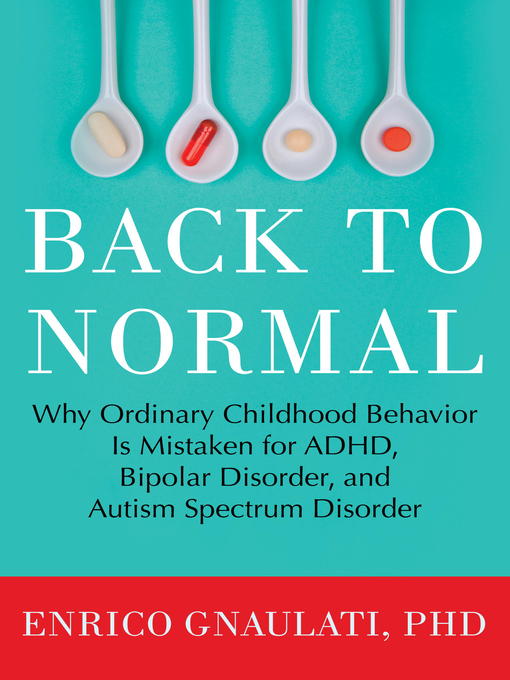
A veteran clinical psychologist exposes why doctors, teachers, and parents incorrectly diagnose healthy American children with serious psychiatric conditions.
In recent years there has been an alarming rise in the number of American children and youth assigned a mental health diagnosis. Current data from the Centers for Disease Control reveal a 41 percent increase in rates of ADHD diagnoses over the past decade and a forty-fold spike in bipolar disorder diagnoses. Similarly, diagnoses of autism spectrum disorder, once considered, has increased by 78 percent since 2002.
Dr. Enrico Gnaulati, a clinical psychologist specializing in childhood and adolescent therapy and assessment, has witnessed firsthand the push to diagnose these disorders in youngsters. Drawing both on his own clinical experience and on cutting-edge research, with Back to Normal he has written the definitive account of why our kids are being dramatically overdiagnosed—and how parents and professionals can distinguish between true psychiatric disorders and normal childhood reactions to stressful life situations.
Gnaulati begins with the complex web of factors that have led to our current crisis. These include questionable education and training practices that cloud mental health professionals’ ability to distinguish normal from abnormal behavior in children, monetary incentives favoring prescriptions, check-list diagnosing, and high-stakes testing in schools. We’ve also developed an increasingly casual attitude about labeling kids and putting them on psychiatric drugs.
So how do we differentiate between a child with, say, Asperger’s syndrome and a child who is simply introverted, brainy, and single-minded? As Gnaulati notes, many of the symptoms associated with these disorders are similar to everyday childhood behaviors. In the second half of the book Gnaulati tells detailed stories of wrongly diagnosed kids, providing parents and others with information about the developmental, temperamental, and environmentally driven symptoms that to a casual or untrained eye can mimic a psychiatric disorder. These stories also reveal how nonmedical interventions, whether in the therapist’s office or through changes made at home, can help children.
Back to Normal reminds us of the normalcy of children’s seemingly abnormal behavior. It will give parents of struggling children hope, perspective, and direction. And it will make everyone who deals with children question the changes in our society that have contributed to the astonishing increase in childhood psychiatric diagnoses.
- Hamilton Reads 2026: The Migrant Rain Falls in Reverse
- Sporty Spice
- New eBook additions
- Curl Up with a Cozy Read
- True North Strong and Well-Read
- Twice-Told Tales
- Warm Up with Holiday Reading
- Remembrance Day Reads
- Explore Your World
- Witch, Please
- Fright Fest
- Always Available Non Fiction
- Just Added - Romance
- See all ebooks collections
- Authentic Atmosphere
- True Crime: For When You Run Out of Podcasts
- Available now
- Canada Reads 2025
- New audiobook additions
- Most popular
- Summer Reading List: Recent Canadian books to read this summer
- Looks Sweet but Could Be Spicy
- Indigenous History and Voices
- Based on a True Story: Page to Screen Edition
- Entering Our Eclipse Era
- BookTok Made Us Do It
- The Hugo and Nebula Awards: 10 Years of the Best
- See all audiobooks collections
- Cooking & Food
- Home & Garden
- Lifestyle
- Fashion
- Health
- Business and Economics
- See all magazines collections
